
The Busy Man’s Blueprint: How to Get in Killer Shape Without Micro-Dosing Movement
Let’s face it: life gets relentlessly busy. Between managing a career, keeping a household running, carving out time for family, and trying to sleep more than six hours a night, the idea of spending ninety minutes commuting to a gym, waiting for a bench press, and sweating through a gruelling workout feels less like a healthy habit and more like a second full-time job.
Plenty of guys genuinely love the traditional gym routine, and if you've got the schedule for it in, lifting heavy iron is fantastic. But what happens when your calendar explodes, work demands peak, and the gym becomes just another source of crushing guilt?
You don’t need to abandon your fitness goals. You just need to change your operating system.
For the busy man, the secret to staying lean, strong, and energised isn't finding more time in the locker room. It’s about micro-dosing movement—breaking your physical activity into high-return, low-friction habits that integrate seamlessly into a packed schedule.
The All-or-Nothing Trap
The biggest lie in modern fitness is that a workout only counts if it is long, complex, and leaves you utterly destroyed.
Society tells us that if you can't carve out an uninterrupted hour for a session, you might as well stay on the couch. This creates an all-or-nothing mindset: “If I can’t hit the gym for a full session today, the whole day is a wash.”
When your schedule is packed, that mindset guarantees you'll do nothing. You miss Tuesday, feel guilty on Thursday, and write off the whole week.
Human biology doesn't care about your schedule's arbitrary blocks. Your muscles, joints, and metabolic system don’t demand an hour of straight dumbbell lifting; they just need regular mechanical tension and movement to stay sharp.

Enter the "Exercise Snack" (or The Power of Micro-Dosing Movement)
Scientists studying metabolic health have popularised a game-changing concept for busy schedules: exercise snacks.
Instead of cramming all your physical exertion into one massive block of time, you distribute short, intense bursts of movement throughout your day. We are talking about two minutes of bodyweight squats while waiting for your morning coffee, or a brisk ten-minute walk after lunch.
It sounds almost too simple to move the needle, but the metabolic payoff is massive. Scattering your movement keeps insulin sensitivity elevated, clears glucose from your bloodstream efficiently, and prevents the cellular stagnation that comes from sitting at a desk like a gargoyle for eight hours straight.
Think of it like watering a houseplant. You wouldn't dump a massive firehose of water on it once a week and let it bake in the sun the rest of the time; you’d give it small, regular drinks. Your metabolism works the exact same way.
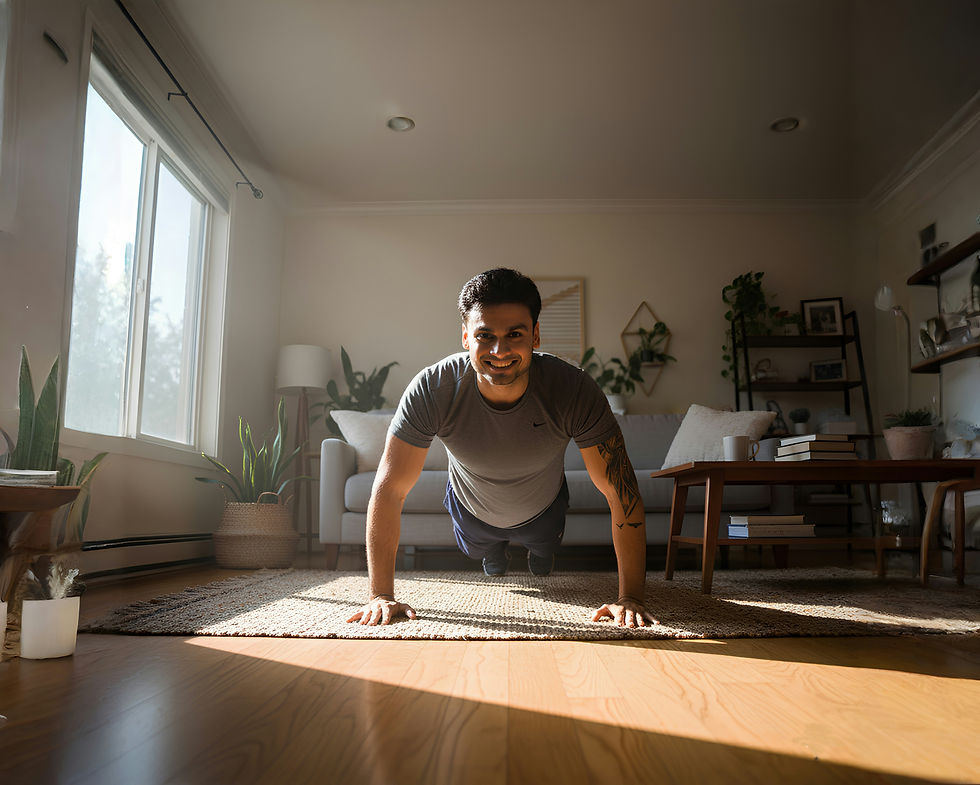
The Zero-Gym Protocol for Busy Schedules
When you don’t have time for a traditional workout, you don’t need fancy equipment or a commute. You t need to weaponise the dead space in your day. Here is how to build a high-performance physique on a brutal schedule:
1. The Post-Meal Stroll
After every workday meal, lace up your shoes and walk briskly outside for 10 minutes.
Why it works: Walking immediately after eating is one of the single most powerful ways to blunt blood sugar spikes. It tells your muscles to soak up glucose from the bloodstream without needing an insulin surge, keeping your energy stable instead of crashing at your desk.
2. The Kitchen Counter Protocol
Whenever you are waiting for something to cook—boiling water, waiting for coffee, or heating up lunch—you owe the universe ten air squats or ten push-ups against the kitchen counter.
The payoff: It sounds trivial, but doing this three times a day adds up to dozens of high-quality reps without taking a minute off your calendar. It maintains baseline muscle tone and keeps your joints lubricated.
3. The Floor Sitting Rule
When you are relaxing at home in the evening, try sitting on the floor instead of slouching on the sofa.
The reality check: Getting up and down from the floor requires core strength, hip mobility, and balance—skills that atrophy fast when your day consists of moving between office chairs, car seats, and couches.
Your 7-Day Micro-Movement Master Schedule
To put this into action, here is a practical, zero-gym weekly roadmap designed to keep your metabolism dialled in without ever setting foot inside a locker room.
Monday: The "Reset & Ramp" Routine
Focus: Reverse weekend desk-sitting and fire up your nervous system for the work week.
Morning (0 min added): While brushing your teeth, do 15 calf raises on the edge of the bathroom floor to get blood flowing to your lower legs.
Mid-Day: Take three separate 5-minute walking breaks during phone calls or email triage. Just pace the hallway or step outside.
Evening: The 60-second floor test: Get down on the floor to play with kids or pets, then get back up without using your hands for support. Do this 3 times.
Tuesday: The Core & Posture Protocol
Focus: Counteracting forward-head desk posture and lower back fatigue.
Morning: While the coffee machine brews, do 10 slow, controlled counter push-ups, focusing on shoulder blade retraction.
Mid-Day: Every time you switch to a new project or task, stand up and do 5 deep overhead reaches (reach as high as you can on your toes) to decompress the spine.
Evening: Post-dinner 10-minute brisk walk. No phone, just steady cadence.
Wednesday: The Mid-Week Metabolic Spike
Focus: Lower blood sugar and keep energy steady through the mid-week slump.
Morning: 15 bodyweight squats before stepping into the shower. Keep your chest up and move deliberately.
Mid-Day: Implement the "Water Glass Rule"—every time you finish a glass of water, do 10 slow air squats before refilling it. (Aim for 3 rounds today).
Evening: Sit on the living room floor instead of the couch for 20 minutes while watching the news or reading.
Thursday: The Upper-Body Tension Release
Focus: Relieving shoulder and trap tightness from marathon keyboard sessions.
Morning: 10 doorway stretches (hands on the frame, lean forward gently) paired with 10 deep diaphragmatic breaths.
Mid-day: Two separate 10-minute outdoor walks immediately following lunch and after mid-afternoon coffee.
Evening: While dinner cooks, do 3 sets of 10 tricep dips on the kitchen counter or wall push-ups.
Friday: The Mobility & Rotational Flow
Focus: Unlocking the hips and thoracic spine before the weekend.
Morning: Alternate high-knee marches in place for 1 minute while reviewing your daily calendar.
Mid-Day: Do 5 slow, deliberate spinal twists (standing torso rotations) every time you stand up to use the restroom.
Evening: Wind down with a 15-minute neighbourhood walk. Notice how much lighter your legs feel than they did Monday morning.
Saturday: The Weekend Errand Stack
Focus: Weaponising natural life logistics for active recovery.
Morning: Turn a standard grocery run or errand trip into a movement session by parking at the very back of the lot and walking with purpose.
Mid-Day: If you’re at home doing chores, carry laundry or groceries up and down stairs with an extra deliberate, slow tempo on the way down.
Evening: Take a longer, unstructured 30-minute family or solo walk without tracking metrics or listening to work podcasts.
Sunday: The Active Prep Day
Focus: Priming the physical slate for the week ahead.
Morning: 10 slow morning air squats and a full-body stretch routine (touching toes, opening chest) before breakfast.
Mid-Day: A brisk outdoor walk or do 20 minutes of light yard work/garage tidying.
Evening: Lie flat on your back on the floor and do 60 seconds of deep, slow breathing to signal to your nervous system that the weekend is transitioning into calm, focused rest.

Why Micro-Dosing Movement Sticks When Everything Else Fails
The beauty of micro-dosing movement for a busy life isn't just physical; it's psychological.
When fitness requires zero logistics—no packing a gym bag, no fighting traffic, no waiting for equipment—the barrier to entry drops to zero. You never feel guilty about missing a session because your entire day is built around keeping your vehicle moving.
You won't get the absurd hypertrophy of a professional bodybuilder this way. But if your goal is to look sharp in a tailored jacket, walk up three flights of stairs without breaking a sweat, and stay metabolically bulletproof while running a demanding career and family life?
You can stop treating fitness like a chore that demands a sacrifice of your precious time. Your body will quietly and steadily get stronger as you live your life.
Footnote: If you happen to see a guy doing calf raises while waiting for a frozen pizza to spin in the microwave, or aggressively pacing the hallway during a conference call about Q3 deliverables, please do not be alarmed. He is not having a medical emergency. He is simply "optimising his metabolic architecture." Or losing his mind. The science is still out.


Comments