
6 Classic Movies Every Gentleman Should Quote
Updated: Jul 19
Six cinematic weapons for your conversational arsenal (and how to use them without clearing out the room).
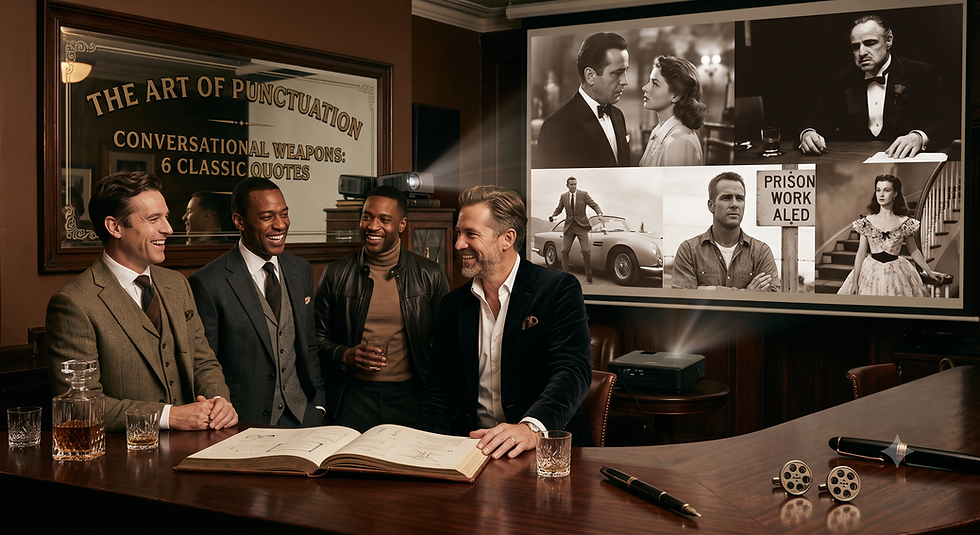
A gentleman doesn’t dominate a conversation; he punctuates it.
Let’s be honest: we’ve all witnessed the guy who treats a casual dinner party like his own personal audition tape, loudly reciting entire monologues from The Godfather while the rest of the table stares intensely at their salads. Don't be that guy.
The true art of the cinematic quote lies in its subtlety. It’s about deploying a single, razor-sharp line from the golden age of cinema with such casual, effortless timing that half the room thinks you just made it up on the spot. Whether you need the quiet authority of Don Corleone or the resilient, charming defiance of Paul Newman, the right quote at the right moment says everything about your wit—and your taste.
Here are six cinematic weapons every man should have in his conversational arsenal, along with the rules on exactly how to fire them.
6 Classic Movies We Suggest
Here are six classic films every gentleman should know—and occasionally quote.
1. Casablanca

Few films have contributed more memorable dialogue to popular culture than Casablanca. Humphrey Bogart’s Rick Blaine remains the model of the wounded romantic who maintains his composure even as the world collapses around him.
The essential quote is: “Here’s looking at you, kid.”
It is affectionate without being sentimental and romantic without sounding desperate. It works best as a quiet toast, preferably delivered over a proper drink rather than shouted across a crowded room.
Another useful line is: “We’ll always have Paris.” Save that one for departures, reunions or relationships that have acquired a little history.
2. The Godfather

A gentleman should not imitate Don Corleone too enthusiastically—particularly during negotiations—but The Godfather offers several lines that have become part of everyday language.
The obvious choice is: “I’m gonna make him an offer he can’t refuse.”
Used playfully, it can introduce anything from a business proposal to an invitation for lunch. The line works because everyone understands the implication, even when the “offer” is merely tickets to a hockey game.
For moments requiring family diplomacy, remember: “It’s not personal, Sonny. It’s strictly business.”
3. Goldfinger

Every gentleman should have at least one James Bond quotation available. While several Bond films qualify, Goldfinger captures the elegance, danger and dry humour that defined the early franchise.
When Bond asks, “Do you expect me to talk?” the villain replies: “No, Mr. Bond, I expect you to die.”
It is gloriously dramatic and perfect for joking about an impossible deadline, a punishing workout or any household repair that has gone terribly wrong.
Bond himself also provides a useful introduction: “Bond. James Bond.” Substitute your own name when the occasion demands unnecessary confidence.
4. Gone with the Wind

“Frankly, my dear, I don’t give a damn” remains one of cinema’s great declarations of emotional independence.
Naturally, this quote requires judgment. It should never be directed at someone sharing genuine feelings, nor should it appear during a performance review, wedding ceremony or discussion with airport security.
Used among friends, however, it remains a wonderfully stylish way to dismiss a trivial problem.
5. The Wizard of Oz

Classic quotations do not need to sound tough. Some of the most useful lines acknowledge that events have become strange, confusing or completely unmanageable.
“Toto, I’ve a feeling we’re not in Kansas anymore” is ideal whenever circumstances take an unexpected turn. It works during travel, corporate restructuring, awkward parties and any visit to a restaurant where the menu requires translation.
For nervous moments, there is also the Cowardly Lion’s memorable encouragement: “Courage!”
6. Cool Hand Luke

Paul Newman’s rebellious prison drama gave cinema one of its most adaptable lines: “What we’ve got here is failure to communicate.”
It can be deployed whenever instructions have been misunderstood, messages ignored or a simple plan has somehow produced chaos. The line has enough authority to sound serious while remaining recognizable as a joke.
That balance is the essence of quoting classic films well. The gentleman uses cinema not to dominate a conversation, but to enrich it. Choose your moment, keep the delivery understated and never explain the reference unless someone asks.
After all, as Rick Blaine might say, this could be the beginning of a beautiful friendship.
The "Please, For the Love of God, Stop Saying This" List
There is a fine line between a well-timed cinematic punctuation and looking like a walking IMDB trivia page. If you find yourself reaching for these three overused clichés, take a sip of your drink, count to ten, and stay silent.
"Toto, I’ve a feeling we’re not in Kansas anymore." (The Wizard of Oz)
The Offense: Saying this the exact moment you step out of a regional airport terminal or pull into a slightly unfamiliar parking lot.
The Reality: It’s been used in literally hundreds of other TV shows and movies as a lazy trope. Unless a tornado genuinely just dropped your house on a witch, let it rest.
"Frankly, my dear, I don't give a damn." (Gone with the Wind)
The Offense: Deploying this during a minor, low-stakes argument with a significant other—like deciding between takeout Thai or Italian.
The Reality: Clark Gable’s delivery was the ultimate mic-drop of 1939 cinema, born out of a massive, sweeping wartime heartbreak. Using it because you don't care about the fabric softener brand just makes you look melodramatic.
"Shaken, not stirred." (Goldfinger / James Bond)
The Offense: Ordering a standard, mid-shelf gin martini at a local dive bar and looking at the bartender expectantly.
The Reality: Ian Fleming actually had Bond order his martinis shaken because he thought it preserved the flavor, but most mixologists agree that shaking bruises gin and dilutes the drink too quickly. If you want to order like a gentleman, just tell them your preferred spirit and garnish without the theatrical performance.



Comments